
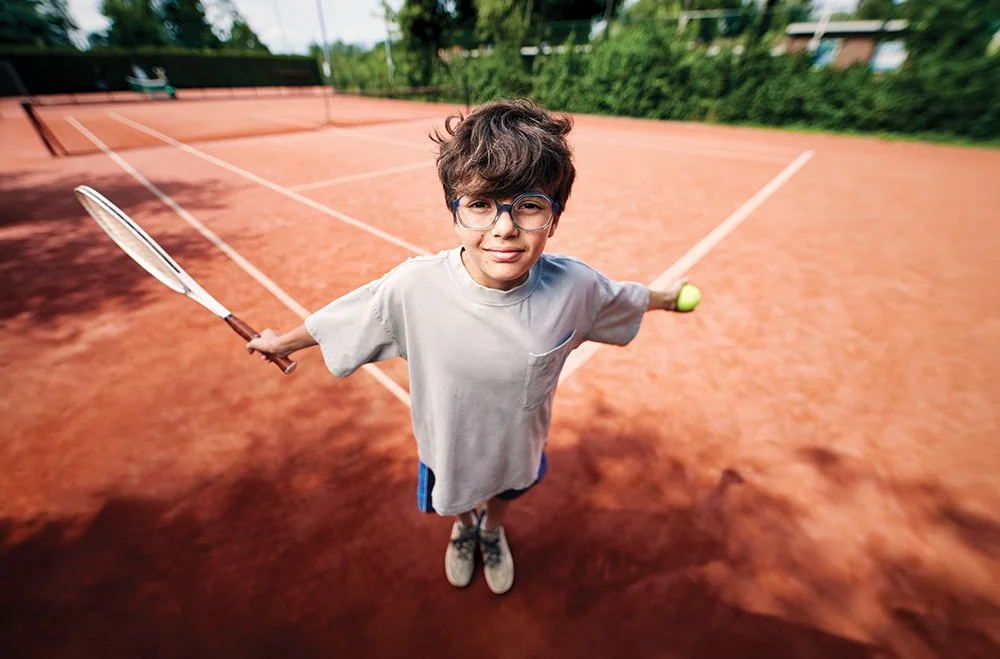
CHILDREN’S EYE CARE
Children's eyes aren't small adult eyes. They need someone who knows the difference.
We test children from age 4 using equipment and techniques designed for kids — not a scaled-down version of an adult exam. If something's wrong, we find it early. If everything's fine, you'll know for sure.
Medically Reviewed by Dr. Mark Joung B.Optom (Hons) UNSW, Grad Cert Ocular Therapeutics | Updated March 2026
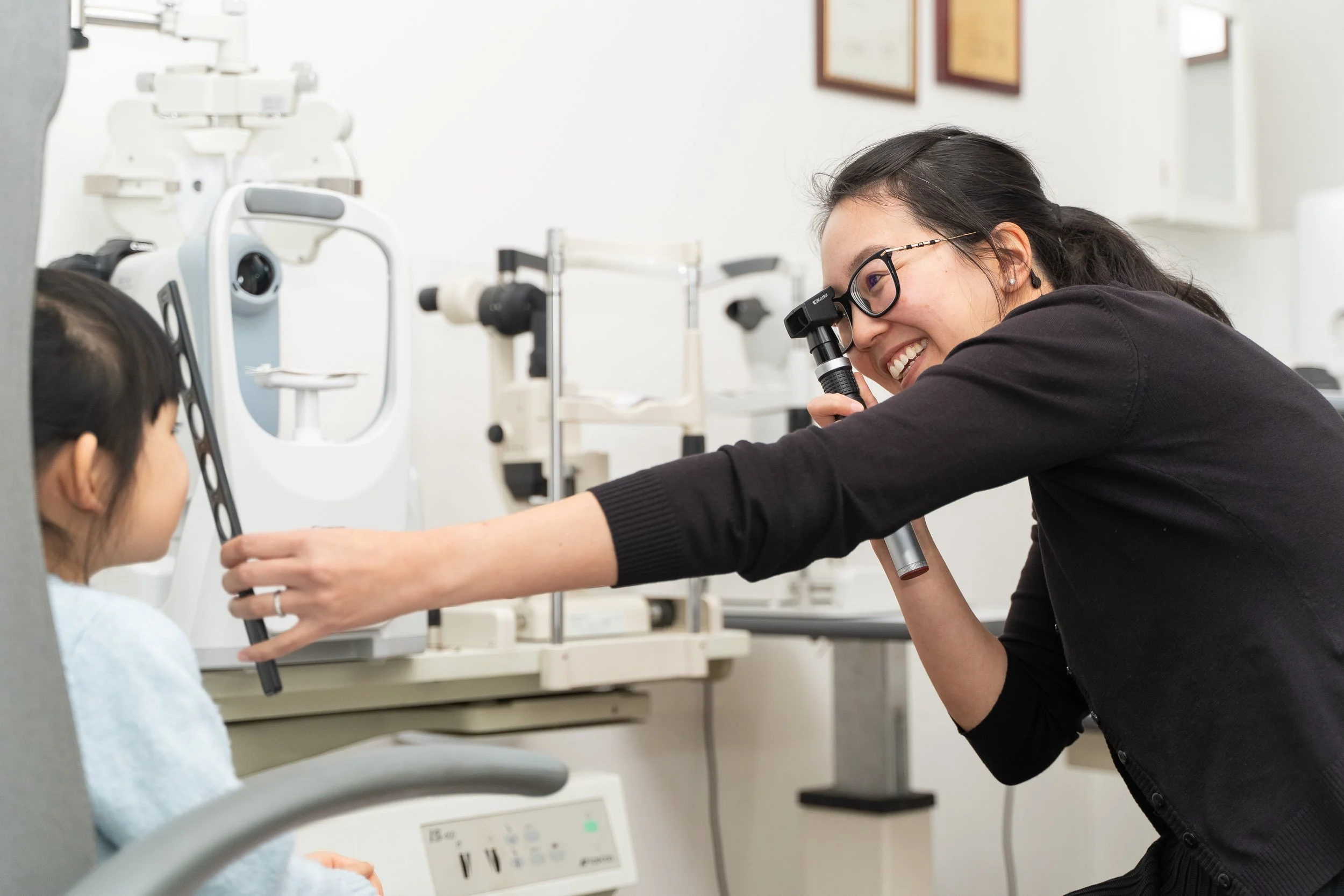
Why Early Children’s Vision Testing Matters for Learning
Most vision problems in children go undetected
Kids don't know what "normal" vision looks like. If they've always seen the world a certain way, they won't tell you something's wrong — because to them, nothing is. That's why they can't just read a chart like an adult and get a meaningful result.
School screenings only catch a fraction of vision problems. They test distance vision — but they don't assess how well your child's eyes work together, whether they can focus up close for reading, or whether there's an underlying condition developing.
A proper children's eye test looks at the whole picture. And with all three of our optometrists trained in advanced paediatric eye care, your child isn't being seen by someone who "also does kids" — they're being seen by people who've made it a special interest.
SIGNS TO WATCH FOR
You might not notice a problem. But these clues can help.
Children rarely complain about their vision. Instead, they show it through behavior. Select any signs you have noticed in your child below.
Awaiting Input...
Select any behaviors above to see our clinical recommendation.
Clinical Disclaimer: This symptom checker is an educational screening tool, not a diagnostic instrument. It does not replace a comprehensive medical eye examination. If your child is exhibiting any of these behaviors, a full functional assessment at Concord Eyecare is required to determine the underlying cause.
Clinical References: The behavioral indicators and risk weightings in this tool are derived from the Evidence-Based Clinical Practice Guideline: Comprehensive Pediatric Eye and Vision Examination published by the American Optometric Association (AOA).
Want the full list of signs — by age?
Our parent's guide covers preschool, primary school, and high school — plus what to do if you spot something.
What’s Included in Our Comprehensive Children’s Eye Test?
A proper children's eye test goes well beyond the chart
School screenings check one thing — distance vision. We check more than eight. Here's what a comprehensive assessment covers.
Distance & near vision
How clearly your child sees at range and up close — using age-appropriate tests, not just a letter chart.
Focusing ability
Can their eyes shift focus smoothly between near and far? This is critical for classroom learning — board to book and back.
Eye teaming & alignment
Do both eyes work together as a pair? Misalignment or poor coordination causes double vision, headaches, and reading difficulty.
Eye tracking
Can their eyes follow a moving target smoothly? Poor tracking makes reading exhausting — they lose their place, skip lines, re-read.
Colour vision
About 8% of boys have some form of colour vision deficiency. We test for it because schools don't — and it affects learning.
Prescription check
Using objective measurement (retinoscopy) — we don't rely on your child's answers to determine if they need glasses.
Eye health
Checking the front and back of the eye for any structural or health concerns — including early signs of conditions that develop in childhood.
Myopia risk assessment
If your child is short-sighted or at risk, we measure progression and discuss whether myopia control is appropriate.
Ready to book your child's eye test?
or call (02) 8765 9600 — bulk billed, no referral needed
A Stress-Free Guide to Your Child’s First Eye Test
What to expect — so you and your child feel prepared
No surprises. Here's how the visit works from start to finish.
Allow 30–40 minutes
We take our time. No rushing. If your child needs a break, that's fine.
Kid-friendly tests
We use pictures, shapes, and games — not just letters. Designed for kids who can't read yet.
Parent stays throughout
You're in the room the whole time. We explain what we're testing and why as we go.
Plain-language results
No jargon. We'll explain exactly what we found, what it means, and what (if anything) needs to happen next.
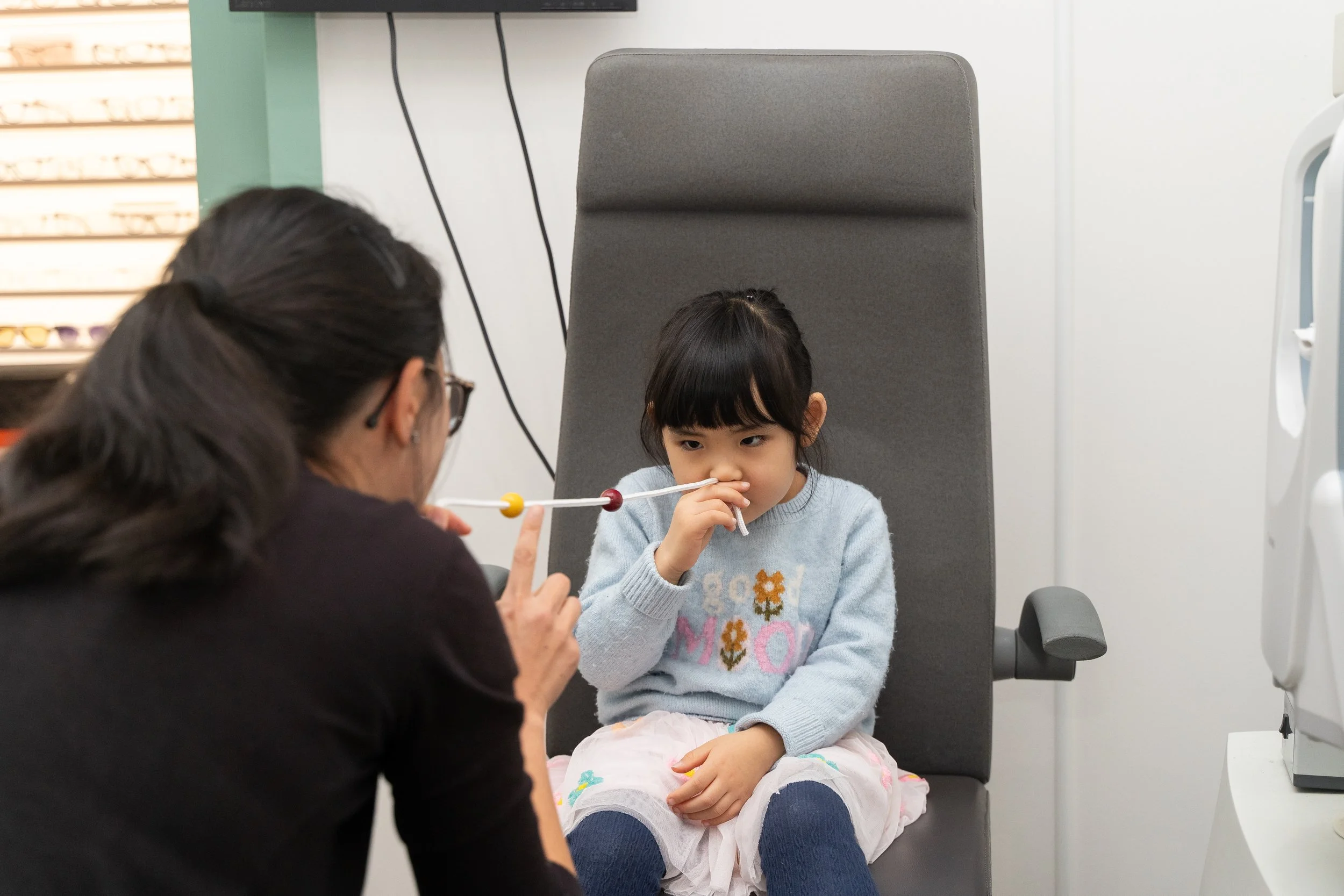
BEHAVIOURAL ASSESSMENT AND VISION THERAPY
When the eyes are healthy but vision still isn't working
Sometimes a child's eyes are perfectly healthy and their prescription is fine — but they still struggle with reading, concentration, or coordination. That's often a functional vision problem: the eyes aren't working together as a team.
Dr Vivian Li has a special interest in behavioural optometry and functional vision assessment. She tests how your child's eyes track, focus, and coordinate — skills that don't show up in a standard eye test but are critical for learning.
If a functional issue is found, Vivian can develop a vision training program tailored to your child. These are in-practice sessions designed to strengthen the visual skills your child needs for reading, writing, and classroom performance.
Recommended ages for Children’s Eye Tests
How often should your child have an eye test?
First eye test
Before they start school. Catches problems early when they're easiest to correct. Bulk billed through Medicare.
Start of primary school
Vision demands increase dramatically. This is when myopia often begins. Annual tests recommended.
Every year
Peak myopia progression years. Also when binocular vision problems start affecting school performance.
Annually or as needed
Screen time increases, prescription may change rapidly. Contact lens fitting becomes an option.
Children's eye tests are bulk billed through Medicare for all Australians aged 4 and over. No referral needed.
Is your child's eyesight getting worse every year?
If your child's short-sightedness is progressing, there are proven treatments that can slow it down — sometimes by 50–60%. We run a dedicated myopia control clinic with transparent pricing and one of the most experienced teams in Sydney.
All pricing published on concordmyopiaclinic.com.au
NORTH STRATHFIELD CHILDREN'S OPTOMETRIST FAQS
Children's eye care — your questions answered
Are children's eye tests bulk billed?
Yes — children's eye tests are bulk billed through Medicare for all Australians aged 4 and over. Your child can be tested every year with no out-of-pocket cost. You don't need a GP referral.
What age should my child first have an eye test?
We recommend a first eye test at age 4, before starting school. This catches problems when they're easiest to correct — and before they start affecting learning.
How do I know if my child needs glasses?
The signs depend on age — preschoolers show different signs to primary schoolers and teenagers. We've written a comprehensive parent's guide covering what to watch for at every age.
Read the Parent's Guide →My child passed their school screening. Do they still need a test?
School screenings only check distance vision. They don't assess focusing, eye teaming, tracking, colour vision, or eye health. Passing a screening doesn't mean everything's fine — it means one thing was checked.
My child can't read letters yet. Can you still test them?
Absolutely. We use picture charts, shapes, and objective tests that don't rely on your child's answers at all. We test children from age 4, including non-verbal children.
What if my child needs glasses?
We'll explain exactly what the prescription means and help your child choose frames they actually like wearing. We stock a wide range of durable, comfortable children's frames — including options designed for active kids.
My child's eyesight keeps getting worse. Can you help?
Yes — this is one of our areas of special interest. Worsening short-sightedness in children can be slowed with treatments like Ortho-K, MiyoSmart glasses, or atropine drops. We run the Concord Myopia Clinic with published pricing and over 1,000 children managed.
Visit Concord Myopia Clinic →Can vision problems cause learning difficulties?
Yes — and they're more common than most people think. Problems with focusing, eye tracking, or eye teaming can look like attention issues or learning difficulties. A proper eye test can rule this out or identify it so we can help.
Do you do vision therapy?
Yes — Dr Vivian Li has a special interest in functional vision and offers vision training programs for children whose eyes aren't working together properly. These are tailored, in-practice sessions that strengthen the visual skills needed for reading and learning.
- Hopkins S, et al. "Undetected eye problems in children — impact on literacy and behaviour." Clin Exp Optom. 2019;102(6):570-579. doi:10.1111/cxo.12898
- Scheiman M, Wick B. Clinical Management of Binocular Vision: Heterophoric, Accommodative, and Eye Movement Disorders. 5th ed. Wolters Kluwer; 2020.
- Holmes JM, Clarke MP. "Amblyopia." The Lancet. 2006;367(9519):1343-1351. doi:10.1016/S0140-6736(06)68581-4
- Kulp MT, et al. "Prevalence of vision disorders in children with reading disability." Journal of AAPOS. 2016;20(6):e24. doi:10.1016/j.jaapos.2016.07.081
- Holden BA, et al. "Global prevalence of myopia and high myopia and temporal trends from 2000 through 2050." Ophthalmology. 2016;123(5):1036-1042. doi:10.1016/j.ophtha.2016.01.006
- Granet DB, et al. "The relationship between convergence insufficiency and ADHD." Strabismus. 2005;13(4):163-168. doi:10.1080/09273970500455436
- RANZCO / Optometry Australia. "Position Statement: Children's Vision." 2020.
- Cotter SA, et al. "Treatment of strabismic amblyopia with refractive correction." Am J Ophthalmol. 2007;143(6):1060-1063.
- Goldstand S, Koslowe KC, Parush S. "Vision, visual-information processing, and academic performance among seventh-grade schoolchildren." Am J Occup Ther. 2005;59(4):377-389.
- Flitcroft DI, et al. "IMI — Defining and classifying myopia: A proposed set of standards." Invest Ophthalmol Vis Sci. 2019;60(3):M68-M88. doi:10.1167/iovs.18-25957
BOOK YOUR CHILD’S EYE TEST
The best time to check is before there’s a problem.
30–40 minutes. Medicare bulk billed. No referral needed. All three optometrists are trained in advanced paediatric eye care.