
DAYTIME MYOPIA CONTROL · SYDNEY
MiSight contact lenses: daytime
freedom, measured results.
Daily disposables that slow myopia by up to 59% — worn during the day, thrown out at night. We teach every child hands-on, and track whether it's actually working with 6-monthly axial length measurements.
ABOUT MISIGHT
More than a contact lens — a
myopia treatment you wear.
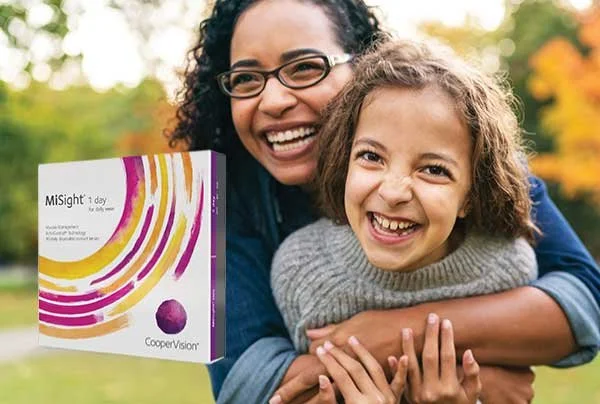
MiSight® 1 day by CooperVision is a soft daily-disposable contact lens designed specifically for myopia control in children. It's the first and only contact lens approved by the US FDA to slow the progression of myopia in children aged 8–12 at the start of treatment.
The lens uses what's called a dual-focus design — concentric rings of correction and treatment zones. These rings let your child see clearly at distance while quietly sending a signal to the eye to slow its growth.
Unlike Ortho-K (worn at night), MiSight is a simple daytime lens. Put a fresh pair in each morning, throw them out at night. No cleaning, no cases, no overnight wear.
HOW IT WORKS
Two optical zones, one lens.
Each MiSight lens has a clear central zone that corrects your child's distance vision — like a normal contact lens. Surrounding that central zone are alternating rings of additional +2.00D power. These treatment rings don't blur your child's vision — the brain ignores them — but they create an optical signal called myopic defocus that slows the eye's growth.
That's the key: MiSight doesn't just correct vision, it actively reduces the signals that drive myopia progression. And because it's a soft disposable lens, there's no fitting precision story to worry about — every lens is identical, and a fresh pair goes in each morning.
CLINICAL EVIDENCE
Up to 59% slower myopia progression.
The landmark 3-year randomised clinical trial of MiSight (Chamberlain et al. 2019, CooperVision FDA trial) found children wearing MiSight had 59% slower myopia progression than children wearing standard single-vision contact lenses. Axial eye elongation — the underlying growth that drives myopia — was slowed by 52% over the same period.
The 6-year extension of that trial (Chamberlain et al. 2022) showed the benefit was sustained long-term. Children who started treatment earlier — closer to age 8 than age 12 — had better long-term outcomes. This is one reason we push parents not to "wait and see" if myopia is already progressing.
The trial is still ongoing. The 7-year follow-up published in 2023 continued to demonstrate sustained slowing, with no rebound effect after children stopped treatment.
IS YOUR CHILD READY
Contacts aren't about age alone — they're about readiness.
The FDA approval window for MiSight is age 8–12 at start of treatment, but age is only part of the picture. Here's what we look for in a readiness assessment.
- Aged 8–12 — inside the FDA approval window
- Willing to try lens handling under instruction
- Washes hands reliably without being reminded
- Wants contacts for sport, self-image, or glasses-free days
- Parent available to supervise the first few weeks
- Under 8 — fine motor skills usually aren't there yet
- Strong reluctance about touching their own eyes
- Active eye allergy or chronic lid inflammation
- Household where hand-washing discipline is inconsistent
- Parent can't commit to supervision during learning phase
OUR PROCESS
How we make contacts safe for 8-to-12-year-olds.
We don't rush through a 5-minute handover. Every MiSight fit runs through the same clinical protocol — one of our optometrists (Mark, Nikki, or Vivian) teaches your child from first contact.
Comprehensive assessment
A full eye examination — prescription, eye health, and a baseline axial length measurement on the Zeiss IOLMaster 500. This baseline is what we'll track against at every review to confirm the treatment is working.
Trial lenses — no obligation
Your child puts in a trial pair and wears them in the clinic. This is the honest test — some children love the feel straight away, some need a second visit, and a small number decide contacts aren't for them. No pressure either way.
Insertion and removal teaching
One-on-one with an optometrist until your child can insert and remove both lenses independently — and, importantly, until their parent is confident watching them do it at home. Most kids pick this up faster than parents expect. We don't move to supply until everyone's ready.
Hygiene walkthrough — what to do, what never to do
Clear rules: fresh lens every morning, throw out at night, never reuse, never swim in them, never sleep in them. We explain why each rule matters — MiSight isn't a toy, and rare eye infections of the cornea do happen when the rules slip.
Collection and review cadence
After the teaching session, we check in at 1 week, then 3 months, then every 6 months. Axial length is re-measured at each 6-monthly review. If progression isn't slowing as expected, we adjust — sometimes by adding low-dose atropine alongside the lenses.
WEAR TIME + HYGIENE
10+ hours a day, a fresh lens every day.
The 59% efficacy figure comes from children wearing MiSight at least 10 hours a day. Part-time wear still gives some benefit, but significantly less. The good news: most children want to wear their contacts — the compliance challenge with MiSight is usually remembering to throw them out at night, not getting them in at all.
On the occasional day your child doesn't wear contacts (illness, home on the weekend, eye feeling irritated), they simply wear regular glasses. The myopia control effect is cumulative — one day off doesn't undo the work of the other days.
- Fresh lens every morning, straight from the blister pack
- Throw out every night — never, ever reuse
- Regular glasses as backup for off-days or when sick
- Hands washed and dried before touching eyes
- Lens care products if eyes feel dry (we'll recommend specific ones)
- Wearing the same lens two days in a row — risk of a rare eye infection isn't worth the saving
- Sleeping in MiSight — it's not an overnight lens, never has been
- Swimming with lenses in — water can carry microbes that cause rare eye infections of the cornea
- Sharing lenses between siblings — contamination risk, don't do it
- Wearing when the eye is red or sore — take the lens out and call us
MEASURING WHAT MATTERS
The only way to know it's working is to measure it.
Here's something most practices don't talk about: with contact lenses, compliance is invisible. You can see whether your child is wearing their glasses. You can't see whether they actually put their MiSight lenses in this morning — or whether those lenses are slowing anything down.
That's why we measure axial length — the physical length of your child's eye in millimetres — at every 6-monthly review, using a Zeiss IOLMaster 500. It's the same optical biometer used in the CooperVision research trials. If the eye is still growing faster than expected, we know MiSight alone isn't enough and we add something to the treatment. If growth has slowed to a normal rate, we keep going. Either way, you're making decisions based on real numbers, not guesses.
Non-contact measurement
A painless one-second scan. Your child rests their chin, looks at a target, and it's done. No drops, no discomfort.
Repeatable to 0.01mm
The precision is good enough to detect real progression changes over 6 months — not enough for us to overreact to normal day-to-day variation.
Trial-grade data
The same device family used in the CooperVision FDA trials. We're comparing your child's progression to the data sets MiSight was actually approved on.
SIMPLE PRICING
A straightforward fit fee — then lenses at your own pace.
Everything's bundled into two parts. No hidden package that locks you in for 12 months.
One-time fit fee
Assessment, training, and all year-one reviews
- Comprehensive myopia assessment
- Baseline axial length on Zeiss IOLMaster 500
- Trial lenses — no obligation
- One-on-one insertion + removal training
- Hygiene protocol walkthrough
- All review consultations for 12 months (1 week, 3 months, and 6 months after teaching)
- 6-monthly axial length measurements
Ongoing supply
Daily disposable MiSight lenses
- MiSight 1 day lenses — prescription matched
- Supplied in sealed sterile blister packs
- Order 3 months at a time — or stock up
- No lock-in after year 1, no cancellation fee
- Pause and switch to glasses-only any time
COMPARE YOUR OPTIONS
How MiSight stacks up against other treatments.
Every evidence-based myopia treatment has strengths. The right choice depends on your child's age, activity, and preferences.
| Treatment | Myopia Slowing | How It's Used | Best For |
|---|---|---|---|
| MiSight Contact Lenses | Up to 59% | Daily disposable — worn during the day | Active kids, sport, freedom from glasses |
| Ortho-K | 50–60% | Night lenses only — no daytime correction | Complete glasses-free daytimes, swimmers |
| MiyoSmart Glasses | Up to 60% | Daytime glasses, simple fit | Younger children, simpler option, no lens handling |
| Low-Dose Atropine | Up to 50% | One drop at bedtime | Usually combined with another treatment |
Many families combine MiSight with low-dose atropine for enhanced control, or keep MiyoSmart glasses as a backup on days when contacts aren't worn.
MISIGHT FAQ
MiSight questions, answered
What age can my child start MiSight?
MiSight is FDA-approved for children aged 8–12 at the start of treatment. Some mature younger children may suit it, and older children can continue using it past 12 — the approval age applies to when treatment begins.
Can my child actually handle contact lenses?
Most kids manage better than parents expect. We teach hands-on — one-on-one with an optometrist — until your child can insert and remove both lenses independently. If they can't, we wait or recommend a different treatment. No pressure.
How much does MiSight cost per year?
Year one is $150 (fit fee) plus $285 every 3 months for lens supply — so about $1,290 all-in for the first 12 months. Year two onwards is just $1,140 in lens supply, with no consultation fees unless you need a review outside the usual schedule.
Can my child swim or play sport in MiSight?
Sport yes, including contact sport — MiSight is ideal for active kids. Swimming, no. Water can carry microbes that cause rare but serious eye infections of the cornea. Take lenses out before pool or ocean. Goggles without lenses, or Ortho-K, work better for regular swimmers.
What if my child doesn't like them?
The trial lens visit is the honest test. If contacts aren't right for your child, we'll know within a visit or two — no financial commitment. We'll look at MiyoSmart glasses or Ortho-K as alternatives.
MiSight or Ortho-K — which is better?
Similar efficacy (59% vs 50–60%). The real difference is routine: MiSight is worn during the day, Ortho-K overnight. Active sporty kids who don't want to fuss with reusable lenses often prefer MiSight. Kids who want complete glasses-free daytimes — especially swimmers — tend to prefer Ortho-K.
Can MiSight be combined with other treatments?
Yes. The most common combination is MiSight plus low-dose atropine at bedtime — used when progression is faster than we'd like with MiSight alone. Read more about atropine for myopia control.
How do you know whether MiSight is actually working?
We measure your child's axial eye length at every 6-monthly review using a Zeiss IOLMaster 500 — the same biometer used in the MiSight trials. If the eye is still growing faster than expected, we adjust the treatment. If it's slowing as hoped, we keep going.

WHY CONCORD EYECARE
Clinical depth and an honest conversation.
We're not going to pretend MiSight is the right answer for every child. It isn't. What we will do is give you a straight readiness assessment, teach your child properly, and track progression with data — not guesswork. Any of our three optometrists (Mark, Nikki, Vivian) can fit and review MiSight.
Experienced MiSight fitter
Years of MiSight experience across Sydney families. We understand where the technology works, where it doesn't, and when to combine it with other treatments.
Objective tracking with IOLMaster 500
Zeiss IOLMaster 500 biometry at baseline and every 6 months. The same device used in the original MiSight FDA trials — research-grade data for your child.
One-on-one optometrist teaching
Your child learns insertion and removal directly from one of our optometrists — not a rushed staff handover. We don't issue lenses until they're confident.
BOOK YOUR MISIGHT CONSULTATION
Ready to see if MiSight is right for your child?
Book a MiSight assessment with Dr Mark Joung, Dr Nikki Peng, or Dr Vivian Li. We'll run a readiness check, measure baseline axial length, and give you a straight answer.
REFERENCES
References
- Chamberlain P, Peixoto-de-Matos SC, Logan NS, et al. A 3-year Randomized Clinical Trial of MiSight Lenses for Myopia Control. Optom Vis Sci. 2019;96(8):556-567.
- Chamberlain P, Arumugam B, Jones D, et al. Long-term Effect of Dual-Focus Contact Lenses on Myopia Progression in Children: A 6-year Multicentre Clinical Trial. Optom Vis Sci. 2022;99(3):204-212.
- Chamberlain P, Bradley A, Arumugam B, et al. Long-term efficacy of dual-focus contact lenses: 7 years of follow-up from the MiSight 1 day clinical trial. Contact Lens and Anterior Eye. 2023.
- Ruiz-Pomeda A, Pérez-Sánchez B, Valls I, et al. MiSight Assessment Study Spain (MASS). A 2-year randomised clinical trial. Graefes Arch Clin Exp Ophthalmol. 2018;256(5):1011-1021.
- CooperVision. MiSight® 1 day Product Information and Instructions for Use. 2019.
- Flitcroft DI, He M, Jonas JB, et al. IMI — Defining and classifying myopia: A proposed set of standards. Invest Ophthalmol Vis Sci. 2019;60(3):M20-M30.