
MYOPIA CONTROL · SYDNEY
Atropine for myopia control:
where it fits in our toolkit
Low-dose atropine eye drops are a genuinely effective myopia treatment — with real side effects and a specific place in how we treat progressing myopia. Here's what the evidence says, how we actually use it, and how it compares to the other options.
ABOUT ATROPINE
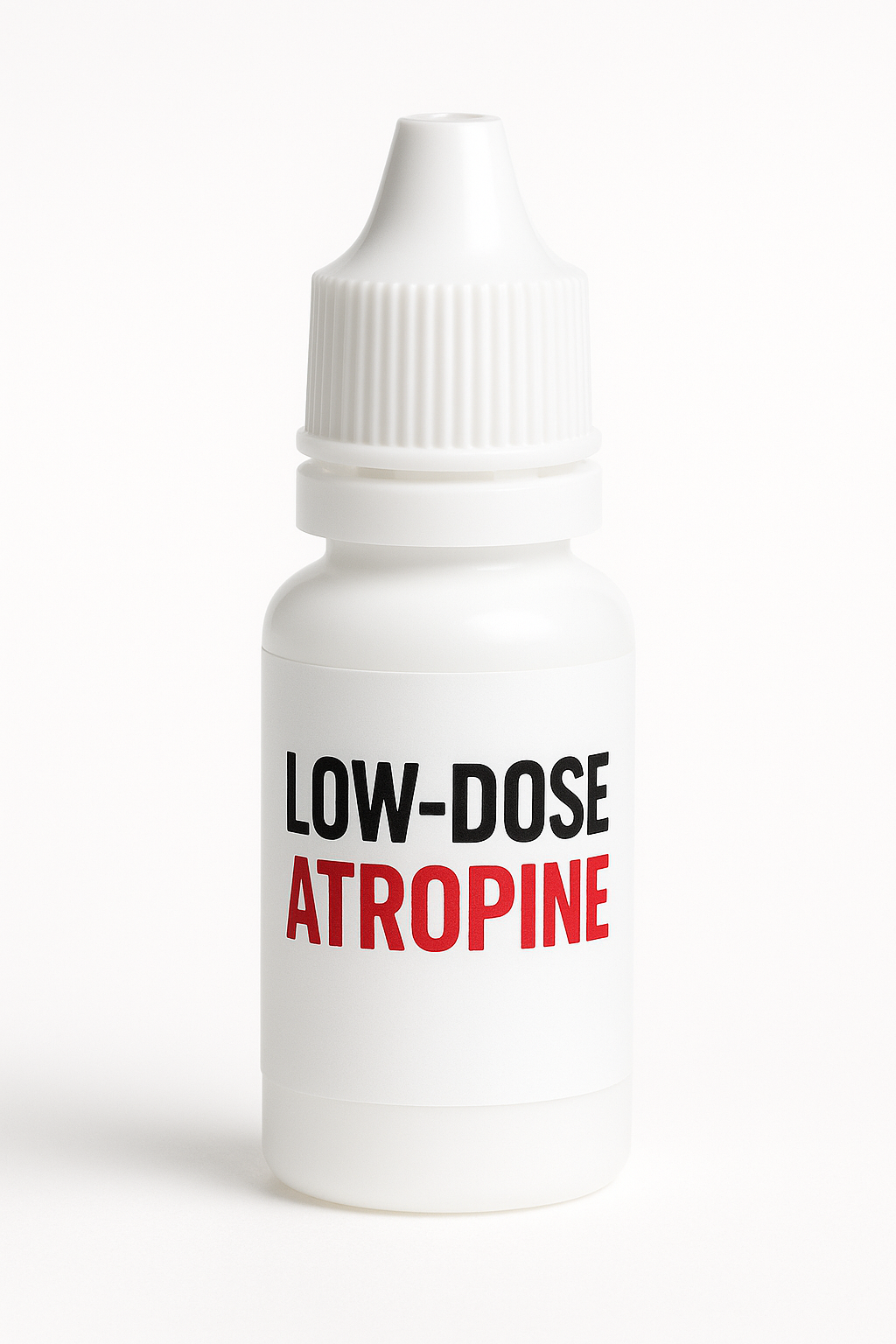
A prescription drop, used at very low doses.
Atropine is a medication that's been used in ophthalmology for well over a century — at high concentrations for eye examinations, and at very low concentrations for slowing myopia progression in children. The "low-dose" matters: we're typically prescribing concentrations 20 to 100 times weaker than what's used for a standard pupil dilation.
At these low doses, the drops are administered as a single drop in each eye at bedtime. They work quietly overnight — there's no lens to wear, no special glasses, no daytime routine your child has to maintain.
The evidence for low-dose atropine in myopia control comes from a series of major clinical trials, most notably the ATOM studies and the LAMP studies out of Singapore and Hong Kong respectively. These have given us a clear picture of what works, what doesn't, and what the side effect profile looks like at each concentration.
HOW IT WORKS
Slowing the eye's growth, at a cellular level.
The science of exactly how low-dose atropine slows myopia is still being worked out, but the current understanding is that it acts on receptors in the sclera — the white outer layer of the eye — and on the retina itself. These receptors appear to influence how quickly the eyeball elongates during childhood growth.
Importantly, low-dose atropine isn't blurring your child's vision into focus. It's not a correction. It's acting as a biological signal that slows the physical growth of the eye. This is why we measure axial length — the actual millimetre length of your child's eyeball — rather than relying on prescription changes alone. Prescription can stabilise for unrelated reasons; axial length tells us whether the drug is actually doing its job.
At the very low concentrations used for myopia (0.01% to 0.05%), the classic atropine effects — pupil dilation and near-blur — are present but reduced. The higher the concentration, the stronger both the myopia-slowing effect and the side effects.
COMPARE YOUR OPTIONS
Atropine is one of four evidence-based options.
There's no single best myopia treatment — the right choice depends on your child's age, lifestyle, progression rate, and what you're comfortable with. Atropine sits in the toolkit alongside three lens-based treatments.
| Treatment | Myopia Slowing | How It's Used | Best For |
|---|---|---|---|
| Ortho-K | 50–60% | Overnight contact lenses | Active kids, swimmers, glasses-free days |
| MiSight Contact Lenses | Up to 59% | Daily disposable, worn in the day | Kids 8–12, sport, freedom from glasses |
| MiyoSmart Glasses | Up to 60% | Daytime glasses, simple fit | Younger children, first-line, simplest option |
| Low-Dose Atropine | Up to ~50% | One drop at bedtime | Combination add-on, or when lenses/glasses aren't suitable |
For most children we see, we start with a lens-based treatment and add atropine only if progression isn't slowing enough at the 6-month review. We'll explain why further down.
EFFICACY BY CONCENTRATION
The dose matters — more than most parents realise.
The most commonly supplied concentration. LAMP2 showed it's meaningfully less effective than 0.05% — and that stopping 0.01% can produce rebound progression. Sometimes used where tolerance to higher concentrations is a problem.
Middle option. Better efficacy than 0.01%, fewer side effects than 0.05%. A reasonable choice where the higher concentration isn't well tolerated.
The evidence-preferred concentration. Strongest efficacy, but also the most noticeable side effects. Where we usually start when atropine is the right call.
These numbers are averages across the trial populations. Some children respond better than average, some less. Axial length at 6-monthly reviews tells us which group your child is in.
Across the three concentrations tested in the LAMP studies (Low-Concentration Atropine for Myopia Progression, Hong Kong), 0.05% atropine slowed myopia progression by around 50%, 0.025% by around 40%, and 0.01% by around 20% — a clear dose-response relationship. Here's how each compares in practice.
IS ATROPINE RIGHT
Great for some kids — but not all
- Your child isn't ready or suited for contact lenses
- Specialty glasses (MiyoSmart/Stellest) aren't working or tolerated
- Progression is fast — more than -0.75D per year — and we want a second mechanism alongside existing lens-based treatment
- Your child is a young progressor and MiyoSmart alone isn't slowing things enough — we add atropine rather than switch away from glasses
- Family is comfortable with a daily medication routine
- Your child handles lenses or glasses well
- You'd prefer a non-medication approach first
- Light sensitivity or near-blur would be a meaningful problem
- Progression is early and moderate — starting with a lens option is usually our default
- You want the strongest single-treatment efficacy available
SIDE EFFECTS
What you'll notice — and what usually won't be an issue.
Atropine dilates the pupil and slightly relaxes the eye's focusing muscle. Here's how those effects show up in real life, and how much of a problem they tend to be.
The most commonly reported effect. More pronounced at 0.05% than at 0.01%. Outdoor light — especially bright Sydney summer sun — can feel uncomfortable, and some children instinctively squint or avoid direct sunlight. Most adapt within a few weeks. For those who don't, transitions lenses or a simple pair of sunglasses solve it. A small minority find the light sensitivity bothersome enough that we reduce the concentration or switch treatments.
Reading and close work can feel slightly fuzzy at higher concentrations, particularly in the first few weeks. Most children compensate naturally — kids' eyes have strong focusing reserve that adults don't. Occasionally we'll add a pair of reading glasses for homework if it's affecting schoolwork, though this is uncommon.
Visible. Your child's pupils will look slightly larger than normal, most noticeably in indoor lighting. This is cosmetic, not harmful. Some parents and kids don't mind; others find it's a consideration.
Common in the first week or two and typically settles within seconds of the drop going in. By week three most children barely notice the drop. Not a reason to stop treatment — just something to expect at the start.
At these low concentrations, systemic absorption is very low. Children generally don't experience headaches, dry mouth, or heart-rate changes that can occur with stronger atropine doses. Allergic reactions to the drops are rare — a little more common in children with other allergies or sensitive skin, but still uncommon overall.
All three main effects reverse within a few days of stopping treatment. None cause permanent visual change. If side effects become problematic, we adjust — lowering the concentration, taking a planned break, or switching to a different myopia control approach. We check in at every review.
MONOTHERAPY VS COMBINATION
On its own, or alongside another treatment?
Monotherapy
Atropine on its own — drops only, no other treatment
This is a legitimate evidence-based approach. The LAMP studies showed 0.05% atropine monotherapy slows progression by around 50% over two years — comparable to the lens-based treatments.
For families where contacts aren't workable, where specialty glasses aren't an option, or where simplicity is a priority, monotherapy is a genuine choice.
Combination
Atropine plus a lens-based treatment
More often, we use atropine alongside another treatment — MiyoSmart glasses, MiSight contact lenses, or Ortho-K. The two approaches work through different biological mechanisms, so combining them can produce better myopia control than either alone — particularly for fast progressors.
The routine fits together neatly. For Ortho-K patients, the atropine drop goes in first at bedtime, then lenses a few minutes later. For MiSight and MiyoSmart patients, the drop simply slots into the evening routine.
OUR APPROACH
How we actually use atropine at Concord Eyecare.
We run a dedicated myopia control clinic, and across the children we manage, atropine sits most often as part of combination therapy rather than as a first-line standalone treatment. That's a clinical position we've arrived at through experience, and it reflects how we read the current evidence base.
There are a few reasons for this approach. The 0.05% concentration — the one with the strongest evidence — has a real side effect profile that affects some children enough that they or their parents want to stop. Lens-based treatments have better day-to-day compliance visibility; a glasses-wearing child is wearing the treatment in front of you, whereas a drop taken at bedtime is harder to confirm. And in our experience, starting with a lens option and using atropine as an adjunct tends to produce the best long-term outcomes in our clinic.
None of this is a reason to dismiss monotherapy atropine. For children who can't tolerate lenses, whose families are uncomfortable with spectacle options, or whose circumstances make a non-lens approach the right call, we prescribe atropine without hesitation — usually at 0.05% based on the LAMP evidence, sometimes at lower concentrations where tolerance is a concern.
The real answer to "should my child be on atropine?" is always a clinical conversation, not a webpage. If you're considering it — whether as a first-line option, as an adjunct, or because another practitioner has suggested it — we'd rather have that conversation face-to-face with your child's full picture in front of us.
WHAT TO EXPECT
A simple visit cadence, and one number for the cost.
Everything's bundled into two parts. No hidden package that locks you in for 12 months.
The initial assessment. If we're considering atropine for your child, the first visit includes a full myopia assessment — cycloplegic refraction, corneal health check, baseline axial length on our Zeiss IOLMaster 500, discussion of concentration choice, and the first written prescription to a compounding pharmacy.
The routine. One drop in each eye at bedtime. That's it. No daytime lens to manage, no special glasses, no adaptation period beyond the first few weeks of mild side effects.
The reviews. We see your child at 6 months and every 6 months thereafter. Each review includes a fresh axial length measurement on the IOLMaster, a refraction check, a side-effect conversation, and a decision about whether to continue, adjust concentration, or change approach. This cadence matches the evidence base — atropine's effect on progression is measured in millimetres of axial length, not weeks of symptoms.
The prescription logistics. We write the prescription directly — no GP referral and no ophthalmologist visit needed first. Eikance (TGA-approved 0.01%) is available via community pharmacies. Higher concentrations — 0.025% and 0.05% — are compounded to order by specialist compounding pharmacies, supplied preservative-free, and can be shipped directly to your home. We'll recommend a pharmacy that's reliable and well-priced.
ATROPINE FAQ
Atropine questions, answered
How effective is atropine for myopia?
Depends on concentration. LAMP showed 0.05% slows progression by around 50%, 0.025% by around 40%, and 0.01% by around 20%. Combination therapy — atropine with a lens-based treatment — is generally stronger than monotherapy.
What are the main side effects?
Light sensitivity and mild near-blur, more noticeable at 0.05% than 0.01%. Pupils look slightly larger than normal. Brief stinging when the drop goes in, usually settles within seconds. Most children adapt within a few weeks. All effects reverse when treatment stops.
Which concentration do you prescribe?
Usually 0.05% where it's well tolerated, based on the LAMP evidence. We'll step down to 0.025% or 0.01% if side effects are a problem or as a starting dose for younger or sensitive children.
Is atropine for myopia TGA-approved in Australia?
Eikance 0.01% is the TGA-registered product in Australia, available via community pharmacies. Higher concentrations (0.025%, 0.05%) are compounded to order by specialist compounding pharmacies on prescription.
Can atropine be combined with MiSight, MiyoSmart, or Ortho-K?
Yes — this is often how we use atropine, particularly when progression is faster than we'd like on a lens-based treatment alone. The two approaches work through different mechanisms, so the combination can be stronger than either alone.
Is atropine covered by Medicare or private health?
No. Atropine for myopia control isn't on the PBS, and private health funds don't cover it. The drops are paid directly to the compounding pharmacy. Our clinical management is billed privately at $45 per visit.
How do I know if it's actually working?
Axial length measurement on our Zeiss IOLMaster 500 at every 6-monthly review. Prescription changes alone can be misleading; axial length is the objective marker that tells us whether the drops are slowing physical eye growth as intended.
What if my child has bad side effects?
We adjust — lower the concentration, take a planned break, or switch to a different myopia control treatment. No lock-in, no refund disputes. Your child's quality of life matters more than staying on a particular treatment.
BOOK A MYOPIA CONSULTATION
The best treatment for your child starts with a conversation.
We'll assess your child's myopia, measure baseline axial length, and walk you through which of the four treatments — atropine, Ortho-K, MiSight, or MiyoSmart — is the right call for your situation.
References
- Yam JC, Jiang Y, Tang SM, et al. Low-Concentration Atropine for Myopia Progression (LAMP) Study: A Randomized, Double-Blinded, Placebo-Controlled Trial of 0.05%, 0.025%, and 0.01% Atropine Eye Drops in Myopia Control. Ophthalmology. 2019;126(1):113-124.
- Yam JC, Li FF, Zhang X, et al. Two-Year Clinical Trial of the Low-Concentration Atropine for Myopia Progression (LAMP) Study: Phase 2 Report. Ophthalmology. 2020;127(7):910-919.
- Yam JC, Zhang XJ, Zhang Y, et al. Three-Year Clinical Trial of Low-Concentration Atropine for Myopia Progression (LAMP) Study: Continued Versus Washout. Ophthalmology. 2022;129(3):308-321.
- Chia A, Lu QS, Tan D. Five-Year Clinical Trial on Atropine for the Treatment of Myopia 2: Myopia Control with Atropine 0.01% Eyedrops. Ophthalmology. 2016;123(2):391-399.
- Optometry Australia. Position Statement on Myopia Management. December 2024.
- Aspen Pharmacare Australia. Eikance 0.01% (atropine sulfate) Product Information. TGA registered 2022.
- Flitcroft DI, He M, Jonas JB, et al. IMI — Defining and classifying myopia: A proposed set of standards. Invest Ophthalmol Vis Sci. 2019;60(3):M20-M30.
- Repka MX, Weise KK, Chandler DL, et al. Low-Dose 0.01% Atropine Eye Drops vs Placebo for Myopia Control: A Randomized Clinical Trial. JAMA Ophthalmol. 2023;141(8):756-765. (CHAMP trial)