

PRECISION MULTIFOCALS & PROGRESSIVE LENS FITTING IN NORTH STRATHFIELD
Tried multifocals and hated them? That's a fitting problem, not a you problem.
Most multifocal failures come down to three things: wrong measurements, wrong lens design for your lifestyle, or wrong frame choice. We fix all three — with precise measurements, personalised lens selection, and the time to get it right.
Medically Reviewed by Dr. Mark Joung B.Optom (Hons) UNSW, Grad Cert Ocular Therapeutics | Updated March 2026
How Progressive & Multifocal Lenses Work
Three pairs of glasses in one — if they’re fitted right.
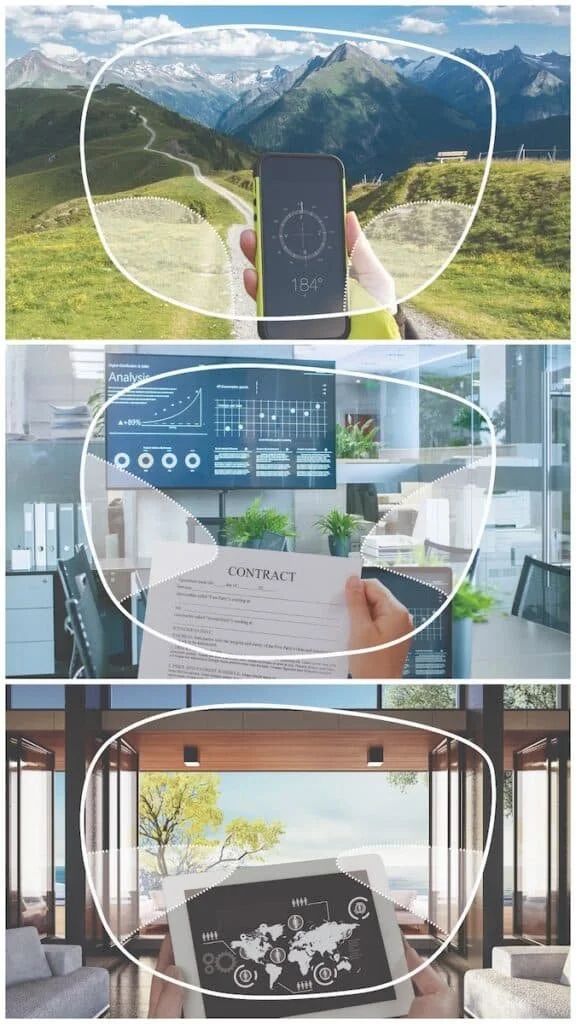
Progressive lenses — also called multifocals — blend your distance, intermediate, and reading prescriptions into a single lens with no visible lines. You look through the top for driving, the middle for your computer, and the bottom for reading.
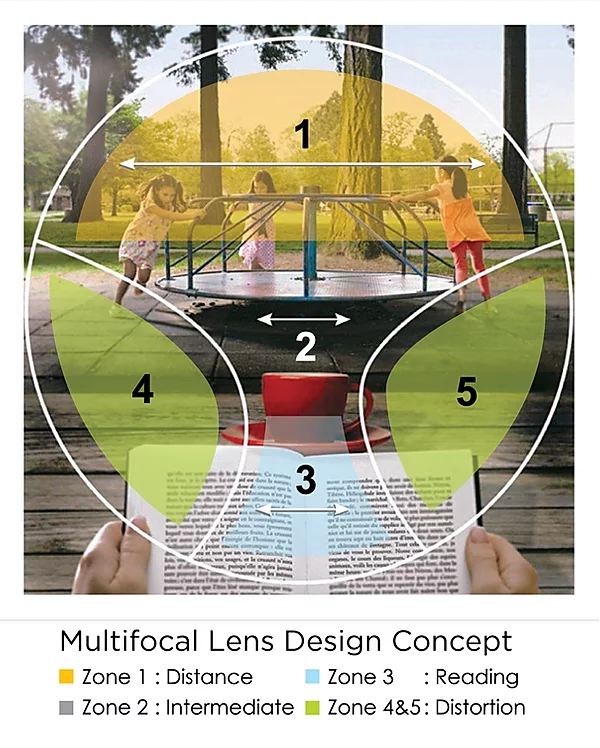
The clear zones are connected by a narrow corridor that runs down the centre of the lens. On either side of that corridor, vision blurs — that's an unavoidable trade-off of the physics. But how much blur, how wide the clear zones are, and how quickly you adapt all depend on two things: the quality of the lens design and the precision of the fitting.
When both are right, progressives work beautifully. When either is off, they're the pair you shove in a drawer.
Common Problems with Multifocal Glasses
The three reasons your progressive lenses aren't working
If you've tried multifocals and given up — or you're putting up with headaches, neck pain, and that "swimming" feeling — the lens probably isn't the problem.
Multifocal Troubleshooting Guide
Are you struggling with your current progressive lenses? Select your symptoms below to find out why.
Precision Lens Fitting & Optical Measurements
Why measurements matter more than the lens brand you choose
This is the part most patients never hear about — and it's the reason many multifocals fail. A premium lens with inaccurate measurements will perform worse than a mid-range lens fitted precisely. The measurements are the foundation everything else is built on.
Every progressive lens fitting starts with a precise refraction during a comprehensive eye examination — the prescription baseline matters more than the lens brand."
Pupil distance — and why each eye is measured separately
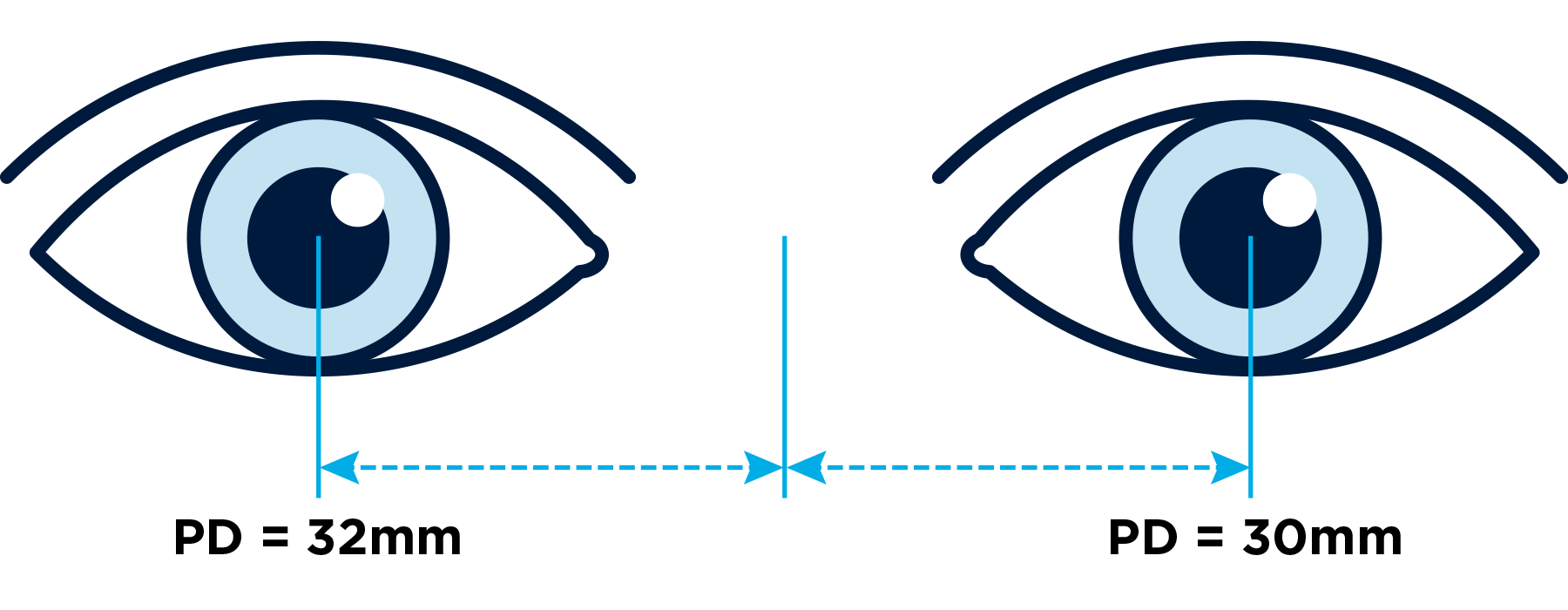
Your pupil distance (PD) tells us where to position the optical centre of each lens so it lines up with your line of sight. Almost nobody has a perfectly symmetrical face — your right eye and left eye sit at slightly different distances from your nose. That's why we measure each eye individually (monocular PD), not a single number across both.
If the PD is off by even 2mm, the corridor of clear vision shifts to one side. On a higher prescription, the effect is larger still. You'd be looking through the distortion zone and wondering why your "expensive" lenses feel terrible.
Fitting height — the vertical alignment
Fitting height tells us where to position the transition point of the lens relative to your pupil when you're looking straight ahead. If it's set too low, you'll look through the intermediate zone when you should be looking through distance — your far vision feels blurry. If it's too high, you can't find the reading zone without dropping your chin to your chest.
This measurement depends entirely on the specific frame you've chosen and how it sits on your face. It changes with every frame. It can't be copied from a previous pair.
How your frame sits — tilt, distance, and wrap
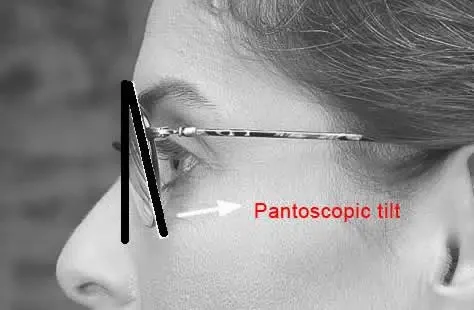
Three additional measurements affect how well a progressive lens performs. Pantoscopic tilt is the vertical angle of the frame — how much it tilts forward. Back vertex distance is how far the lens sits from your eye. Wrap angle is how the frame curves around your face. Premium lens designs use all three to calculate the optics for your specific wearing position.
Without these measurements, the lens falls back to industry-average defaults — typically 8° tilt, 5° wrap, 12mm from the eye. If your frame doesn't match those averages (and most don't), part of the personalisation you're paying for goes to waste.
The bottom line: the research is clear — individually measured progressive lenses consistently outperform every other design tier. Even with small measurement imperfections, personalised lenses still beat standard off-the-rack designs. But the benefit scales directly with measurement precision. That's why we take the time to get every number right.
Ready to get your lenses fitted properly?
or call 02 8765 9600
Our Concord Eyecare Progressive Lens Fitting Process
What expert, personalised fitting actually looks like.
Lifestyle assessment
We ask how you spend your day — screen time, driving, hobbies, work environment. This determines which lens design and zone distribution will work best for you.
Precise measurements
Monocular pupil distances and fitting heights for each eye. Pantoscopic tilt, back vertex distance, and wrap angle for your specific frame. Every measurement taken with care — not a quick ruler across your nose.
Frame selection guidance
We help you choose frames that work for your lenses and your face — minimum depth for the corridor, stable bridge fit, correct weight distribution. The frame is part of the optical system.
Personalised lens selection
Based on your measurements, lifestyle, and budget, we select the lens design and tier that gives you the best result. We fit all major brands and recommend based on your needs — not a supplier deal.
Final frame adjustment
When your lenses arrive, we adjust the frame to sit exactly as measured. A 1mm shift can push you into the distortion zone. We take the time to verify everything before you leave.
Adaptation coaching & follow-up
We explain how to use your new lenses, what's normal in the first week, and when to come back. If something doesn't feel right after two weeks, we re-check the fitting first — not the lens.
How to Adjust to New Multifocal Lenses
Worried about adapting? Here's what your brain is actually doing
Adaptation is the number one concern patients raise about progressive lenses. The good news: with a properly fitted, personalised lens, most people adapt within 1–2 weeks. First-time wearers may need 3–4 weeks. The first few days are the hardest — then it gets steadily easier.
What your brain is doing
When you put on a new progressive lens, your brain needs to learn where each zone is and how to use it. That's why things feel "off" at first — you might notice peripheral blur when you turn your head, a slight swimming sensation, or uncertainty on stairs. This is normal. Your brain is remapping how it interprets visual input through the lens zones, and it usually takes 7–10 days to settle.
What makes adaptation easier
Three factors have the biggest impact. First, lens quality — premium personalised designs with wider corridors and less peripheral distortion produce measurably faster adaptation than standard designs. In clinical studies, customised freeform lenses were significantly preferred over standard designs across distance, intermediate, and near vision.
Second, fitting accuracy. If the measurements are right, your line of sight naturally falls through the correct zone at each distance. If the measurements are off, your brain has to compensate constantly — and that's when people give up.
Third, your addition power. Higher additions (which increase as you age) produce narrower corridors — it's a physics constraint. This means adaptation can be harder at higher prescriptions, which is exactly when precise fitting and premium lens designs matter most.
What to do in the first two weeks
Wear them full-time from day one. Don't switch back to your old glasses — that resets the adaptation clock every time. Point your nose at what you want to see rather than just moving your eyes. Start at home before trying stairs, driving, or busy environments. And give your brain time — most of the discomfort resolves within the first week.
Still struggling after two weeks? Come back. We'll re-check the fitting height, pupil distances, and frame adjustment. The answer is almost always in the measurements — not the lens. Most people adapt within a few weeks when the measurements are right.
Comparing Standard vs. Personalised Progressive Lenses
Not all progressive lenses are the same. Here's what the tiers mean.
Higher tiers don't just cost more — they give you measurably wider clear vision and faster adaptation. Here's what each level actually does for you.
Conventional Design
Lifestyle-Matched
Individual Design
Conventional Front-Surfaced Design
Uses a one-size-fits-all design based on factory-average assumptions. Works for straightforward prescriptions, but the clear zones are narrower and adaptation takes longer.
- Pre-set corridor design
- Fixed zone distribution
- Limited frame compatibility
- Adequate for low adds, simple scripts
Lifestyle-Matched Freeform Design
The sweet spot for most patients. Calculated using your individual measurements and matched to your lifestyle. Wider clear zones, less peripheral distortion, smoother adaptation.
- Lifestyle-adapted zone distribution
- Individual measurements factored in
- Binocular balancing technology
- Wider corridor and reading zones
- Better frame compatibility
Individualized Digital Freeform Design
The widest, sharpest progressive available. Every parameter individualised — your facial anatomy, frame position, visual habits, and prescription all factored into the lens calculation.
- Full position-of-wear optimisation
- Peripheral distortion actively reduced
- Binocular harmonisation for unequal scripts
- Widest clear zones at every distance
- Fastest adaptation technology
Office Lenses vs. Progressive Lenses for Computer Work
Why your multifocals don't work at the computer
This is one of the most common complaints we hear — and it's not a flaw in your lenses. It's a fundamental engineering constraint that affects every progressive lens ever made.
Progressive lenses transition from distance power at the top to reading power at the bottom. The intermediate zone — exactly where your computer screen sits — occupies the narrowest point of that transition. For a typical prescription, the usable width of clear intermediate vision can be as narrow as 2–5mm. That's barely wider than your pupil.
This creates three problems at once. You can't scan your eyes across a wide monitor without hitting peripheral blur — you have to turn your entire head left and right. The intermediate zone sits below the centre of the lens, so you tilt your chin up to look through it — creating sustained neck strain. And as your addition power increases with age, the corridor gets even narrower.
No progressive lens — no matter how premium — can completely eliminate this constraint. It's physics. But dedicated office lenses solve it by redesigning the lens from the ground up for screen distances.
Standard Progressive
usable intermediate zone
Head-turning, chin-tilting, neck strain
Dedicated Office Lens
wider intermediate vision
Natural posture, full eye-scanning
Office lenses: a necessary second pair for computers
Office lenses eliminate the distance zone entirely and redistribute that lens area to near and intermediate vision. Where a standard progressive dedicates around 20–30% of the lens to intermediate distances, an office lens dedicates 60–70%. The result is dramatically wider clear vision at screen distance, a natural relaxed head posture, and significantly less fatigue.
We fit office lenses in three designs — from close reading distance (around 1 metre) to standard computer distance (2 metres) to full room coverage (4–6 metres). They can't replace your progressives for driving or outdoor activities — but for the 6–8 hours a day you spend at a desk, the difference is transformative. Clinical research confirms they reduce visual fatigue and maintain better posture than standard progressives for computer work.
Do you need office lenses? If you spend more than 4 hours a day at a screen, wear progressive lenses, and notice neck strain, headaches, or difficulty seeing your whole monitor — yes. Most patients who try them wish they'd started sooner.
WE FIT THE LEADING LENS BRANDS




North Strathfield Multifocal & Progressive Lens FAQs
Progressive lenses — your questions answered
How long does it take to adjust to progressive lenses?
Most people adapt within 1–2 weeks. First-time wearers may need up to 3–4 weeks. Wear them full-time from day one, point your nose at what you want to see, and give your brain time. If you're still struggling after two weeks, come back — we'll re-check the fitting first.
How do you choose which lens is right for me?
We start with your prescription from a comprehensive eye examination, then factor in your lifestyle — screen time, driving, close work, hobbies. Combined with your measurements and frame choice, that tells us which lens design and tier will give you the best result. We fit all major brands and recommend based on your needs.
Why are your progressives better than what I'd get at a chain?
It's the fitting, not the lens. Chain stores typically take fewer measurements, use standard designs, and have less time per patient. Research on multifocal rechecks finds most trace back to the prescription and the measurements, not the lens itself. Our experienced team takes the time to get every measurement right.
Do I need a separate pair for computer work?
If you spend more than 4 hours a day at a screen and notice neck strain, headaches, or difficulty seeing your monitor clearly — yes. Progressive lenses squeeze computer vision into a 2–5mm corridor. Office lenses give you 3–4 times more usable screen vision.
I tried progressives before and couldn't wear them. Can you help?
Almost certainly. Most people adapt within a few weeks when the measurements are right. We'll work out what went wrong last time — it's nearly always a measurement, frame, or lens design issue — and build from there.
How much do progressive lenses cost?
Progressive lenses range from standard to fully personalised depending on the level of customisation. We'll discuss options and pricing during your consultation. All major health funds accepted via HICAPS for on-the-spot claims.
What frames work best with progressive lenses?
Frames need enough vertical depth to fit the full progressive corridor — generally 28mm minimum. They also need to sit stable and level. We'll guide you through frame selection that works for your lenses, not just aesthetics.
What's the difference between progressive and bifocal lenses?
Bifocals have two zones with a visible line — distance at the top, reading at the bottom, nothing in between. Progressives blend all three distances seamlessly with no line. They look better, give you intermediate vision for screens and dashboards, and are the standard recommendation today.
Sources and clinical evidence
The information on this page is drawn from peer-reviewed research, manufacturer data, and professional optical publications. We believe in transparency — here's where the numbers come from.
- 1 Bist J, Kaphle D, Marasini S, et al. Spectacle non-tolerance in clinical practice — a systematic review with meta-analysis. Ophthalmic and Physiological Optics. 2021;41(3):610–622. — Pooled non-tolerance prevalence of 2.1% across all spectacle types; progressive/multifocal lenses disproportionately represented.
- 2 Beesley J, Davey CJ, Elliott DB. What are the causes of non-tolerance to new spectacles and how can they be avoided? Ophthalmic and Physiological Optics. 2022;42(3):619–632. — 83% of non-tolerance rechecks attributed to poor-quality refractions.
- 3 Pascual E, Gómez-Pedrero JA, Alonso J. Theoretical performance of progressive addition lenses with poorly measured individual parameters. Ophthalmic and Physiological Optics. 2023;43(2):244–253. — 1,900 patient datasets demonstrating individual designs with accurate measurements outperform all other tiers; conventional designs showed 41% of users experiencing noticeable near vision loss.
- 4 Alvarez TL, Kim EH, Granger-Donetti B. Adaptation to progressive additive lenses: potential factors to consider. Scientific Reports. 2017;7:2529. — Vergence dynamics and phoria adaptation significantly greater in patients who successfully adapted.
- 5 Sheedy JE, Hardy RF, Hayes JR. Progressive addition lenses — measurements and ratings. Optometry. 2006;77(1):23–39.
- 6 Han SC, Graham AD, Lin MC. Clinical assessment of a customized free-form progressive add lens spectacle. Optometry and Vision Science. 2011;88(2):234–243. — Randomised, double-masked cross-over trial (n=95); customised freeform lenses significantly preferred over standard designs (p=0.006).
- 7 Sullivan DB. Varilux Infinity field trial results. Points de Vue. 1992;26:44–48. — 720 wearers; 1.1% true non-adaptation when lenses properly fitted.
- 8 Cagnie B, De Meulemeester K, Saeys L, et al. The impact of different lenses on visual and musculoskeletal complaints in VDU workers with work-related neck complaints: a randomised controlled trial. Environmental Health and Preventive Medicine. 2017;22:8. — VDU-specific lenses rated more suitable for computer work; little difference between lens types in visual and neck comfort.
- 9 Minkwitz G. Über den Flächenastigmatismus bei gewissen symmetrischen Asphären. Optica Acta. 1963;10(3):223–227. — Foundational theorem: unwanted astigmatism perpendicular to the corridor increases at twice the rate of power change along it.
- 10 Carl Zeiss Vision. SmartLife wearer testing — Aston University. 2023. — External study (n=182); 81% of SmartLife wearers adapted within one day; 94% of Individual 3 wearers perceived wide comfortable fields for intermediate and near tasks.
- 11 HOYA Vision Care. iD MyStyle 3 wearer study. 2024. — Internal study (n=1,694); 56% faster adaptation, 57% less fatigue, 61% less swaying compared to lenses without AdaptEase/3D Binocular Vision technologies. Proprietary data, not independently peer-reviewed.
- 12 Wittenberg S. Taking the measure of digital centration systems. 20/20 Magazine CE. 2018. — ZEISS internal data: ruler-based PD measurement: average variance ~3mm across operators; digital centration systems: 0.09–0.24mm variance (10–30× more precise).
READY FOR MULTIFOCALS THAT ACTUALLY WORK?
It starts with a proper fitting
Book a progressive lens consultation. We'll take the time to get your measurements right, match you with the right lens, and make sure you're set up to adapt smoothly.