
Colour Vision Testing & Workplace Assessments in North Strathfield
Flagged at work? We'll give you the full picture.
A workplace screening can tell you there's a problem — but not what kind, how severe, or what it means for your job. We run a comprehensive colour vision assessment with four different tests and provide a detailed report for your employer.
Medically Reviewed by Dr. Mark Joung B.Optom (Hons) UNSW, Grad Cert Ocular Therapeutics | Updated March 2026
Understanding Colour Blindness & Deficiencies
Colour vision deficiency is more common than most people think.
About 8% of men and 0.5% of women have some form of colour vision deficiency. Most are born with it and have adapted so well they don't know they have it — until a workplace screening flags it.
Children are sometimes flagged at school screenings too — often as a surprise to both the child and the parents. Early identification helps teachers adapt how they use colour-coding in the classroom and avoids years of quiet frustration.
Colour vision deficiency isn't a single condition. It ranges from mild difficulty distinguishing certain shades to a near-complete inability to see specific colours. The type and severity matter — especially for your work. Some forms have no practical impact. Others may affect your ability to identify colour-coded wiring, signals, or safety markings.
A basic screening test can detect a problem, but it can't classify the type or severity. That's what our comprehensive assessment does.
Pre-Employment Colour Vision Tests
Common reasons patients require a comprehensive colour vision report
Electricians & tradies
Flagged during pre-employment or licence screening. Need a detailed report confirming type and severity for your employer or licensing body.
Police & emergency services
Applicants for police, fire, and emergency response roles often require specific colour vision clearances using the Farnsworth D-15 during recruitment.
Rail & transport
Train drivers and rail safety workers need documented colour vision assessment. Our multi-test approach provides the detail required.
Lab & medical staff
Pathology, pharmacy, and laboratory workers who need to distinguish colour-coded samples, medications, or test results.
Children flagged at school
Your child's school screening picked up a colour vision issue. We'll confirm the type and severity, and provide guidance for teachers on how to support your child in the classroom.
Pre-employment screening
Any role where colour identification is safety-critical. We provide the documentation your employer needs.
Ishihara, Farnsworth D-15 & Advanced Colour Vision Tests
Why a single screening test isn't enough to give you the complete picture
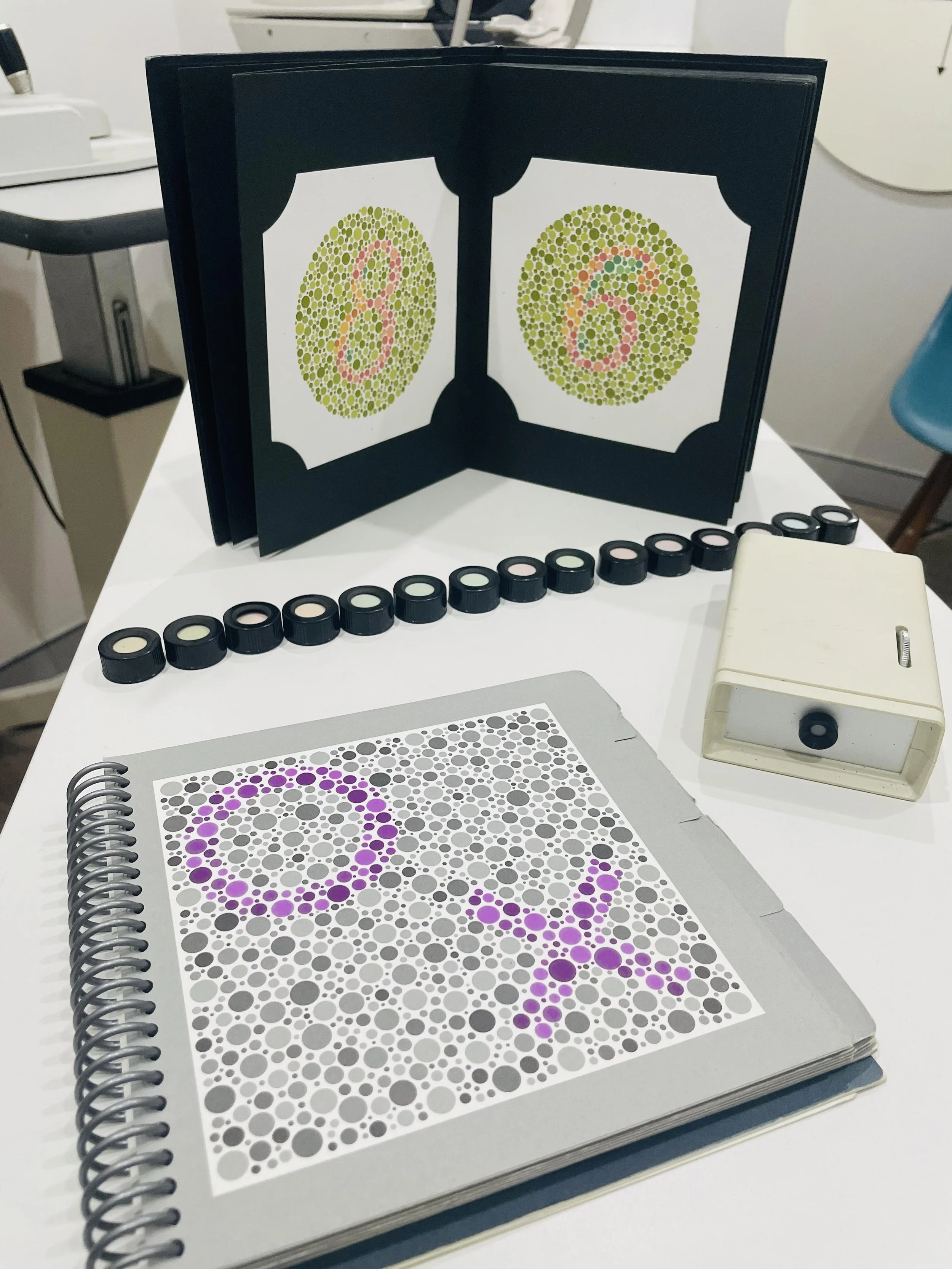
Most optometrists run one test — the Ishihara plates. We run four, because a single test can detect a deficiency but can't fully classify the type or severity.
Ishihara Pseudoisochromatic Plates
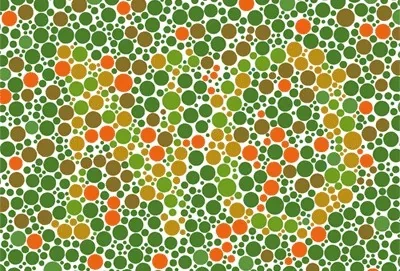
The test most people recognise — coloured dots with hidden numbers. Highly sensitive for detecting red-green deficiency but doesn't measure severity or classify the exact type. This is the test most workplace screenings use, and the one that probably flagged you.
HRR Pseudochromatic Plates
Similar format to Ishihara but designed to detect both red-green and blue-yellow deficiencies. It also grades severity into mild, medium, or strong — giving us more information than Ishihara alone about how significant your deficiency is.
Farnsworth D-15
You arrange 15 coloured caps in order. The pattern of errors reveals the type of deficiency (protan, deutan, or tritan) and its axis. Particularly useful for determining whether your colour vision is adequate for safety-critical work — it separates mild deficiencies from clinically significant ones.
Medmont C-100
A computerised test that provides precise, quantified results under standardised conditions — removing the variability of printed plates under different lighting. Measures colour discrimination across the full spectrum with accuracy that printed plates can't match.
Why four tests? No single colour vision test gives the full picture. Ishihara screens. HRR grades severity. D-15 classifies the type and determines practical impact. Medmont C-100 quantifies it precisely. Together, they give your employer — and you — a clear, documented answer about your colour vision.
Our Concord Eyecare Assessment Process
What to expect: From your initial booking to the final workplace report
Book in
Call or book online. Let us know it's for colour vision testing so we allocate the full 45 minutes. No referral needed.
Eye examination
We start with a comprehensive eye exam to rule out any underlying causes of acquired colour vision deficiency — including eye disease, medications, or neurological issues.
Four-test assessment
Ishihara, HRR, Farnsworth D-15, and Medmont C-100 — all run under controlled lighting conditions. We explain what each test measures as we go.
Report & support
We prepare a written colour vision report documenting type, severity, and practical implications for your work or school requirements. Available within a few business days.
Managing Colour Vision Deficiency at Work and School
A failed screening doesn't necessarily mean you can't do your job
Many patients come to us stressed — they've been flagged at work and they're worried about their career. Here's what we want you to know: the majority of colour vision deficiencies are mild, and many have no practical impact on workplace safety.
The purpose of our assessment isn't to help you pass a test. It's to accurately classify what you have, measure how significant it is, and document it clearly so your employer can make an informed decision based on their specific requirements.
Colour vision deficiency is genetic in most cases — it's not something that developed because of a health problem, and it won't get worse over time. There's no treatment or cure, but understanding exactly what you have helps you and your employer manage it practically.
For children, early identification means teachers and parents can make simple adjustments — labelling colours on worksheets, avoiding colour-only instructions, seating your child where lighting is best. It's not a learning disability — it's a manageable difference.
Important: We provide a colour vision report, not a certificate. The report documents your test results, the type and severity of any deficiency, and the clinical interpretation. It's then up to your employer or licensing body to determine fitness for your specific role based on their requirements.
North Strathfield Colour Vision Testing FAQs
Colour vision testing — your questions answered
How much does a colour vision test cost?
The comprehensive colour vision assessment is $95. This includes all four colour vision tests, a full eye examination to rule out any underlying causes of acquired colour vision deficiency, and a detailed written report for your employer. Medicare does not cover colour vision assessments for workplace purposes.
Do I need a referral?
No. You can book directly — adults and children. If your employer has provided a specific form or request, bring it with you and we'll make sure the report addresses what they need.
How long does the assessment take?
Approximately 45 minutes. This covers the comprehensive eye examination plus all four colour vision tests. We explain results as we go, so you'll leave understanding exactly what your results mean.
Why do you include a full eye examination?
Most colour vision deficiency is inherited and present from birth. But some conditions — including certain eye diseases, medications, and neurological issues — can cause acquired colour vision changes. A comprehensive eye examination rules these out, so we can confirm whether your colour vision is an inherited trait or something that needs further investigation.
Can anything help with colour vision deficiency?
There's no cure for inherited colour vision deficiency. However, we fit Iro tinted lenses which help colour-deficient patients read Ishihara plates, and may improve differentiation of certain colours for deutans and some protans. They don't restore normal colour vision and won't guarantee a workplace screening result — but they can make a practical difference. We can discuss whether they're suitable during your assessment.
I failed the Ishihara test at work. Does that mean I can't do my job?
Not necessarily. Ishihara is a screening test — it detects deficiency but doesn't measure severity. Many people who fail Ishihara have mild deficiency with no practical workplace impact. Our full assessment classifies exactly what you have so your employer can make an informed decision.
Will the report say if I'm fit for my job?
The report documents your test results, type and severity of deficiency, and clinical interpretation. Fitness-for-role decisions are made by your employer or licensing body based on their specific requirements — not by us. But the information we provide is what they need to make that call.
My child was flagged at school. What should I do?
Book a colour vision assessment. We'll confirm the type and severity, explain what it means in practical terms, and provide guidance you can share with your child's teacher. About 8% of boys have some form of colour vision deficiency — it's common and very manageable once identified.
Can children be tested?
Yes. We test children from school age. The tests are straightforward and don't require reading — your child just needs to identify numbers in coloured dots or arrange coloured caps in order. We explain everything in a way that's easy for kids to follow.
What do I need to bring?
Bring your Medicare card, any paperwork or forms from your employer, and your current glasses if you wear them. If your employer has specified a particular test or standard they need, let us know when you book so we can address it in the report.
Have a question not listed here?
Call us on (02) 8765 9600- Birch J. "Worldwide prevalence of red-green color deficiency." J Opt Soc Am A. 2012;29(3):313-320. doi:10.1364/JOSAA.29.000313
- Cole BL. "The handicap of abnormal colour vision." Clin Exp Optom. 2004;87(4-5):258-275. doi:10.1111/j.1444-0938.2004.tb05056.x
- Birch J. "Identification of red-green colour deficiency: sensitivity of the Ishihara and American Optical Company (Hardy, Rand and Rittler) pseudo-isochromatic plates to identify slight anomalous trichromatism." Ophthal Physiol Opt. 2010;30(5):667-671.
- Dain SJ. "Clinical colour vision tests." Clin Exp Optom. 2004;87(4-5):276-293. doi:10.1111/j.1444-0938.2004.tb05057.x
- Vingrys AJ, Cole BL. "Origins of colour vision standards within the transport industry." Ophthal Physiol Opt. 1988;8(4):365-375.
- Hasrod N, Rubin A. "Defects of colour vision: A review of congenital and acquired colour vision deficiencies." African Vision and Eye Health. 2016;75(1):a365. doi:10.4102/aveh.v75i1.365
- Simunovic MP. "Colour vision deficiency." Eye. 2010;24(5):747-755. doi:10.1038/eye.2009.251
- Cole BL. "Assessment of inherited colour vision defects in clinical practice." Clin Exp Optom. 2007;90(3):157-175.
READY WHEN YOU ARE
Come and meet us
No referral needed. We’re open Monday to Saturday at 161 Concord Rd North Strathfield. Book online or give us a call.